How to Replace Flyscreen Mesh, Step by Step
Remesh a window flyscreen yourself. Tools, materials and costs, removing old spline, tensioning without bowing the frame, corners, trimming and mistakes.
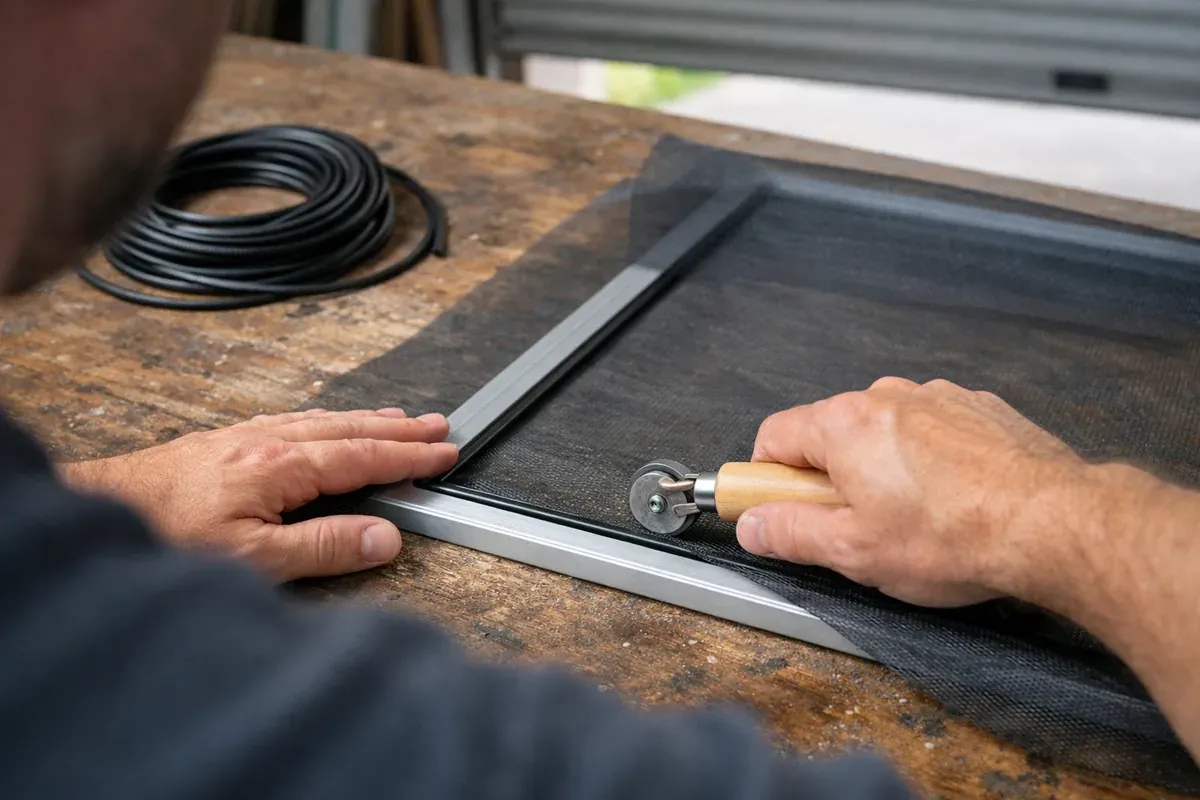
To replace flyscreen mesh, you take the screen out, pull out the rubber spline that holds the old mesh, lay new mesh over the frame and roll new spline into the groove so it grips the mesh, then trim off the excess. On a standard aluminium window screen the materials cost about $20 to $30 from Bunnings, and the only special tool is a spline roller.
The usual trouble spots are mesh pulled so tight it bows the frame, corners that bunch up, and a knife that slips while trimming.
What you need
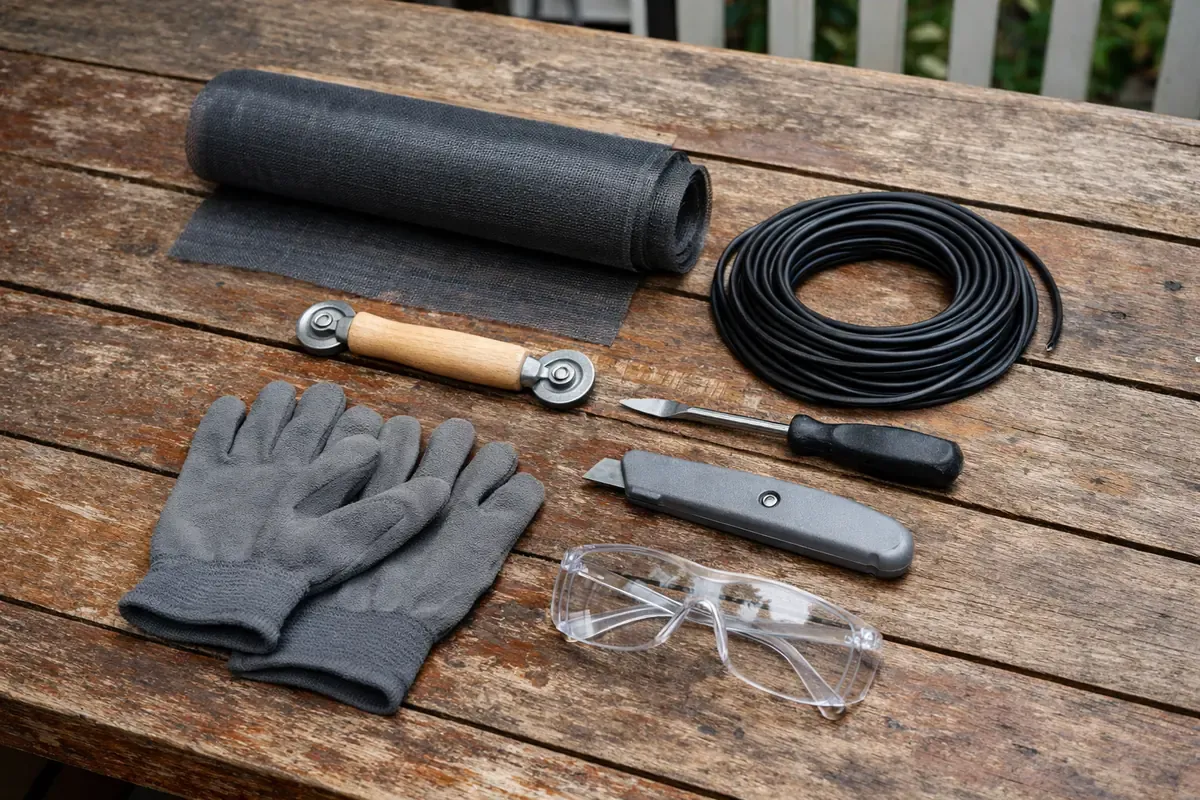
- Flyscreen mesh, cut from a roll at least 50 mm wider and longer than the frame. Fibreglass is the easiest to work with. Our mesh types guide compares the others.
- Spline in the right diameter for your frame (more on this below).
- A spline roller. Most have a rounded (convex) wheel at one end and a grooved (concave) wheel at the other.
- A flat-blade screwdriver to lift out the old spline and push spline into corners.
- A sharp utility knife with a fresh blade, or a flyscreen trimmer.
- Tape measure, plus masking tape or a couple of clamps.
- Gloves and safety glasses. Bunnings’ flyscreen mesh guide says to wear the right safety gear, and old aluminium mesh has sharp edges.
- A flat work surface bigger than the screen: a table, a sheet of plywood on trestles, or a clean floor.
What it costs to remesh a flyscreen yourself
These are Bunnings Australia online prices checked in November 2026. They change often and vary by store, so treat them as a rough guide.
| Item | Size | About |
|---|---|---|
| Cyclone fibreglass flyscreen | 910 mm x 2 m | $11 |
| Cyclone fibreglass flyscreen | 1220 mm x 2 m | $16 |
| Cyclone aluminium flyscreen | 910 mm x 2 m | $24 |
| Cyclone pet mesh flyscreen | 910 mm x 2 m | $31 |
| Rolltrak 6 mm black spline | 13 m | $9 |
| Rolltrak 2 in 1 spline roller (with trimming knife) | $9 |
So a first fibreglass screen comes to about $30 including the roller, and each extra screen is mostly the cost of mesh. A 13 metre pack of spline goes around a 900 x 1200 mm screen about three times. You can see the 910 mm fibreglass mesh and the 2 in 1 roller on the Bunnings site.
For what a screen business charges to do the same job, see our flyscreen repair cost guide or try the cost calculator.
Pick the right spline
Spline that is too thin falls out or lets the mesh slip. Spline that is too thick will not roll in, or it splits and pushes the frame out of shape.
The surest way to match it is to take a piece of the old spline to the shop. If it is too squashed to judge, note that Rolltrak PVC spline at Bunnings comes in 4.5 mm and 6 mm, and Cyclone foam spline in 5.0 mm and 5.7 mm. Rolltrak’s spline listing suggests 4.5 mm with aluminium or stainless mesh and 6 mm with fibreglass, because metal mesh takes up more room in the groove. If you are switching mesh type in an old frame, buy both and test a short length in a corner. Our spline sizes guide goes into more detail.
How to replace flyscreen mesh
- Take the screen out. Release the clips or turn buttons and lift the screen out of its track. If it is stuck, or it is on an upper floor, read how to remove a flyscreen first. Work from inside on upper floors and never lean out a window to reach a screen.
- Note which side faces out. The spline groove side is usually the outside face. A strip of masking tape marked “out” saves confusion later.
- Remove any clips or handles that cover the spline groove, and keep the screws together.
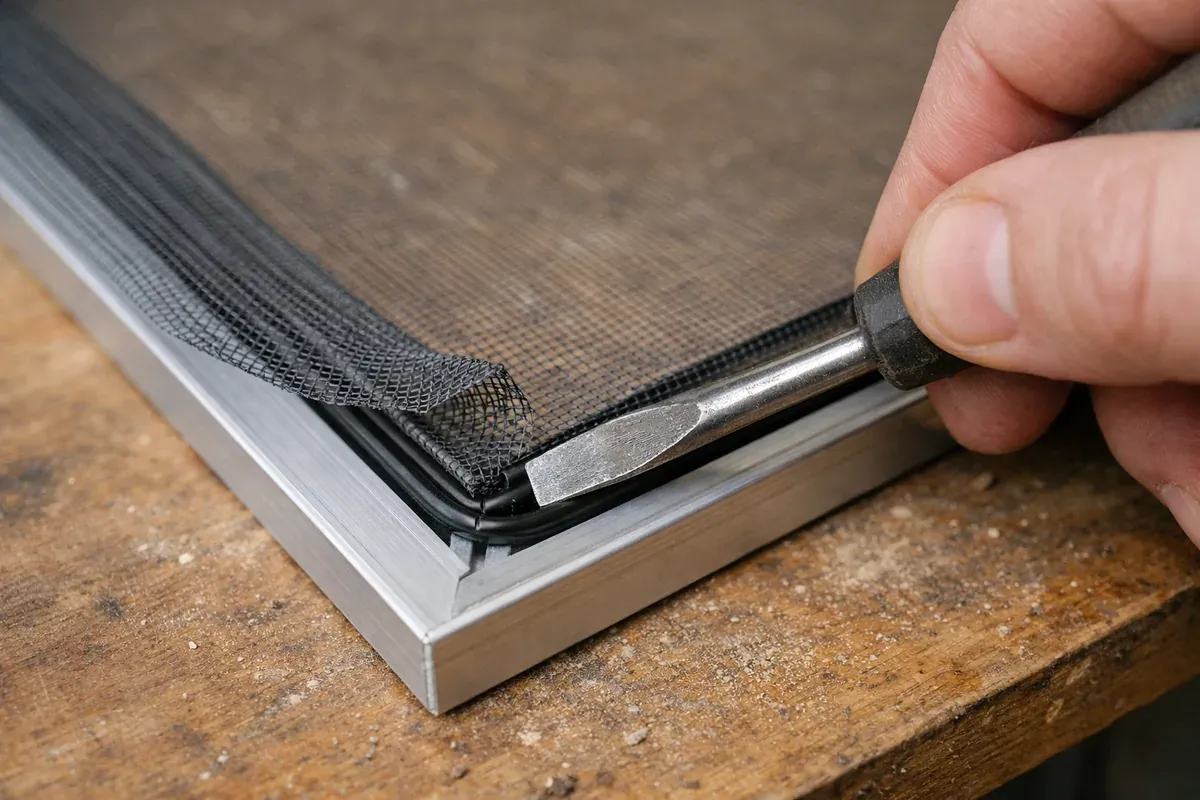
- Find the end of the old spline (often at a corner) and lift it with the tip of a flat screwdriver. Then pull it out by hand all the way around. Go slowly near the corners so you do not lever against the frame and bend it.
- Lift out the old mesh and clean the groove. Dirt, grit and bits of old spline stop the new spline seating.
- Check the frame is square. Measure corner to corner both ways. If the two diagonals match, the frame is square. If they are a few millimetres out, press gently on the long corners until they match. If a corner is loose, cracked or separated, stop here (see the last section).
- Lay the new mesh over the frame, square to the edges, with 25 to 50 mm of overhang on every side. Do not stretch it yet. Tape or clamp it to the table along one edge so it cannot shift.
- Brace the long sides. Put a block of timber or a heavy object against the inside middle of each long side, or clamp the frame to the table. This stops the frame being pulled inwards as the mesh tightens.
- Cut a small notch at each corner. Snip a 45 degree cut across the overhanging mesh at each corner, stopping just short of the groove. This lets the mesh fold into the corner without bunching.
- Roll in the first side. Start at a corner. With fibreglass, lay the spline over the mesh and roll it in with the concave wheel in one pass. With aluminium, first run the convex wheel gently along the groove to crease the mesh into it, then roll the spline in on top with the concave wheel.
- Push the spline into the corner with the screwdriver or the corner tool on your roller, then turn it and carry on along the next side without cutting it. One continuous length holds better than four pieces.
- Do the opposite side next, then the remaining two. As you roll, pull the loose mesh outwards lightly with your free hand to take up slack. Let the spline do the tensioning: it pulls the mesh tight as it goes into the groove.
- Cut the spline where it meets the starting point and press the end in firmly.
- Trim the excess mesh. Run a sharp knife along the outside edge of the spline, with the blade angled away from the screen so it cannot cut the new mesh. Change the blade if it starts to drag.
- Refit the clips and handles, take out the braces and check the screen sits flat. Then put it back in the window.
Getting the tension right without bowing the frame
Flyscreen frames are thin and bend easily. Stretch the mesh hard by hand and the long sides pull inward, so the screen will not sit in its track or leaves gaps for insects. Aim for mesh that is flat with no ripples, not drum tight.
- Work in opposite pairs, with the long sides braced until all four sides are done.
- Check as you go. After the second side, look along the frame edge. If it has already started to curve in, back the spline out and redo that side with less stretch.
Common mistakes
- Trimming before all four sides are in. The mesh can creep out of the groove while you are still tensioning. Trim last.
- Pressing too hard with the roller. It stretches the spline, can split aluminium mesh and makes the roller more likely to slip off and cut the new mesh.
- Using a blunt knife. It drags the mesh out from under the spline and gives a ragged edge.
- Buying mesh that is too narrow. Without enough overhang there is nothing to hold, and the mesh pulls out of the groove on the last side.
When a bent frame or broken corner means getting someone in
New mesh does not fix a damaged frame. Get a screen business in, or ask for a new frame, if:
- A side is kinked or bent. Aluminium flyscreen frame that has been creased cannot be straightened well. The usual fix is a new length of frame or a whole new frame, which needs a mitre saw and the right parts.
- A corner is cracked, loose or pulled apart. The corners are joined with corner stakes that fit inside the frame. They are cheap (a 4 pack of Rolltrak plastic stakes for 22 mm frame is about $2 at Bunnings), but replacing one means taking the frame apart and matching the frame size exactly. If you are not confident doing that, it is a quick job for a screen business.
- The frame will not go square, or the screen no longer fits its track even with new mesh.
- It is a security screen. Security mesh is usually held in by clamps or a system specific to the brand, not by spline. Security screens are tested to an Australian standard (currently AS 5039.1:2023), and changing how the mesh is fixed may affect that, so ask the manufacturer or installer before touching one, or leave it to a specialist.
- It is a large sliding screen door. These can be remeshed at home, but they are harder to keep straight and often have worn rollers too.
- The screen is on an upper floor and can only be reached from outside. Working at height is not worth the risk for a flyscreen.
You can get a quote for remeshing or frame repairs, or find a local screen business near you.
Questions
Can I reuse the old spline?
You can if it is still soft and round, but most old spline is hard, cracked or flattened by the sun and will not grip new mesh properly. New spline costs about $9 for a 13 metre pack at Bunnings, so it is rarely worth the risk.
Which side of the frame does the mesh go on?
The mesh goes on the side with the spline groove. Note which way the screen faced in the window before you take it apart so it goes back the same way.
Why is my flyscreen frame bowing in after remeshing?
The mesh was pulled too tight, or one side was finished before the opposite side was started. Pull the spline out of the worst side, let the frame straighten, and roll it in again with less stretch and the long sides braced.
Can I remesh a flyscreen without taking it out of the window?
Sometimes, if the frame is fixed and you can reach the spline groove, but it is much harder to get even tension. A screen laid flat on a table gives a far better result.
How long does it take to remesh a flyscreen?
It depends on the screen and your experience, so give yourself an unhurried session for the first one, because rushing is when the mesh wrinkles or the knife slips. The next screens go much faster.